

The Environmentally Friendly Face-Off
Sure, glass might seem like the greener option at first. But when we dive into the nitty-gritty of life cycle analysis, the reality is quite different. Our HDPE pots have a feather-light carbon footprint - just 6.3 grams of CO2 equivalent per functional unit. In contrast, glass bottles can generate up to 5.8 times more waste by weight and rack up higher transport emissions thanks to their hefty nature. So, while glass might look great on your shelf, it comes with an environmental price tag that’s hard to ignore.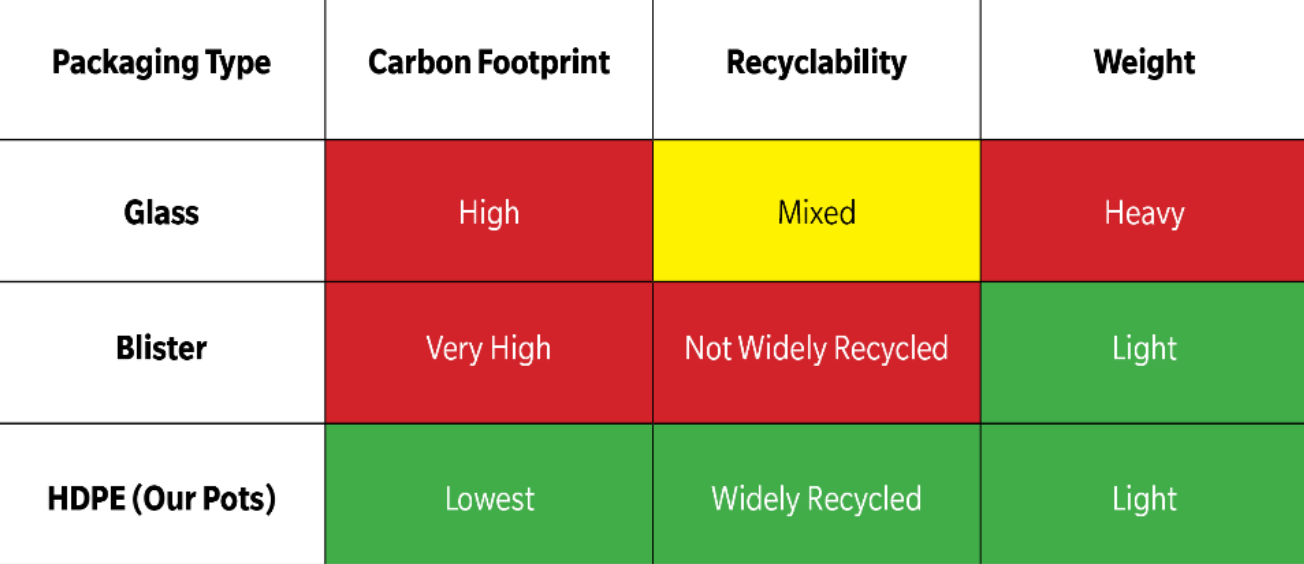
Why HDPE is the Real MVP (Most Valuable Player)
- Lower Emissions: Here’s a fun fact: our HDPE pots produce up to five times fewer CO2 emissions than their glass counterparts over their lifetime. That’s a number worth celebrating!
- Lightweight Wonder: HDPE is as light as a feather compared to glass, which means less fuel used during shipping. Less fuel = smaller carbon footprint. It’s a simple equation that’s easy to get behind!
- Local Logic: Best of all we use a UK manufacturer for over 95% of our packaging which is produced just down the road from where your products are made and packed!
- Recyclable Rockstar: Our HDPE is more than just a pretty face - it’s widely accepted in curb side recycling across the UK. Meanwhile, composite glass packaging can often be left out in the cold when it comes to recyclability.
- Built to Last: Forget about fragile glass! Our HDPE pots are tough and resealable, ensuring your supplements stay safe, fresh and effective. Plus, they’re easier to store than those pesky blister packs that seem to have a mind of their own.
Setting the Record Straight on Plastics
Now, we get it - plastics can raise eyebrows. But not all plastics are created equal! The high-grade, food-safe HDPE we use is chemically stable and doesn’t leach harmful substances or shed microplastics. It’s the same trusted material used in pharmaceuticals, so rest assured, your health is in good hands.Blister packs
Eager to enhance the sustainability of our entire product range, we set out to explore whether HDPE pots truly outshine blister packs in cartons as the eco-champions. Our thorough investigation into these two packaging options has revealed valuable insights!Recyclability
In the recycling showdown, HDPE pots come out on top. They’re like the popular kid at school - made from a single, widely recycled plastic that most curb side collection services happily accept. Meanwhile, traditional blister packs are a mixed bag of PVC and aluminium, making recycling them a nightmare!
Material Efficiency
Using an HDPE pot instead of blister packs contained within a carton means your supplements are wrapped up in a fraction of the material. When it comes to sustainability, using less non-recyclable materials (hello, blisters!) is always a wining choice.Carbon Footprint
HDPE's lightweight design is like a featherweight champion, helping to keep transportation emissions low. Comparably speaking, blister packs are also light in weight. However, due to the extra carton they are packed within, more materials are being used – less is best, as they say.Consumer Perception
While some may view supplements in blister packs and cartons as more premium, we want to assure you that this is simply a misconception. Moving from blisters in cartons to HDPE pots not only maintains the integrity of our exceptional formulas but also enhances your experience. Our products remain unchanged in quality, now presented in packaging that boasts superior recyclability. You’re still getting the same outstanding product, but with an added layer of environmental mindfulness.In our extensive research into sustainable packaging, we are confident that transitioning to HDPE pots is the best way to champion environmental practices without compromising on quality. We hope you too can embrace the change - the planet will thank you!
What about pouches?
While pouches may seem like the eco-friendly champions of the vitamin world with their lightweight charm and minimal material use, they often hide a dirty little secret: mixed materials that are the recycling equivalent of a bad breakup -complicated and hard to deal with. On the other hand, HDPE pots, though they might look like they hit the gym a little too hard with their bulk and rigidity, offer a solid commitment to recyclability. They’re the sturdy friends who stand by you through thick and thin, being widely accepted in most recycling programs and in high demand for their second act as recycled materials. They’re reliable, recyclable, and ready to make a positive impact!Better together
Let’s cut to the chase about why matching materials for pots and labels is the savvy choice for recyclability. Think of it this way: when you use the same material for both, you're not just being stylish; you're streamlining the recycling process! Mixed materials create a sorting headache for recycling facilities, leading to contamination and wasted resources. But with HDPE pot and label in perfect harmony, they can be processed together, making recycling a breeze. Which is why we’re updating all our range to full HDPE material ( aka a mono-material) from top to bottom. With over 200 products, bear with us, it’s not an overnight job!Using one material means the pot, with label attached, leaves our customers in no doubt how to recycle their empties. So, choosing matching materials isn’t merely a design decision; it’s a powerful step toward a circular economy. It’s about making every bit count while looking good doing it.
The Greener Choice Isn’t Always Glass
In conclusion, while glass may have its charm, HDPE emerges as the unsung hero of packaging. Our commitment to using HDPE pots reflects our dedication to both your health and the health of our planet.So, the next time you reach for your favourite supplements, remember: the packaging matters! We’re proud to offer you a smarter, greener alternative that balances the best of science whilst respecting nature. Let’s continue this conversation - your thoughts and questions are always welcome as we navigate this exciting journey together! Contact us, we’d love to hear from you.
Reference
- Cooreman-Algoed, M., Boone, L., Evelien Uitterhaegen, Sue Ellen Taelman, Wouter De Soete and Dewulf, J. (2023). Environmental life cycle assessment of nutraceuticals: A case study on methylcobalamin in different packaging types. Science of The Total Environment, 893, pp.164780–164780. doi:https://doi.org/10.1016/j.scitotenv.2023.164780.
- Environmental life cycle assessment of nutraceuticals: A case study on methylcobalamin in different packaging types - ScienceDirect.
Explore more: