


With summer on the horizon, many Brits are trading sofa time for step counts as they try to boost their fitness ahead of the warmer months.
But staying active is not just seasonal; regular movement supports both physical health and mental well-being all year round. So, how easy is it to keep moving where you live?
To find out, our team of in-house experts at Nature’s Best assessed access to indoor and outdoor exercise opportunities across the UK.
The results reveal a clear divide. In some cities, staying active is effortless; in others, it takes far more work, proving that while motivation matters, environment and lifestyle play a major role.
Which UK cities rank top when it comes to maintaining an active lifestyle?
Taking a seed list of the 40 most popular cities in the UK, we analysed 10 factors across indoor and outdoor facilities to reveal which ones had the best access to an active lifestyle
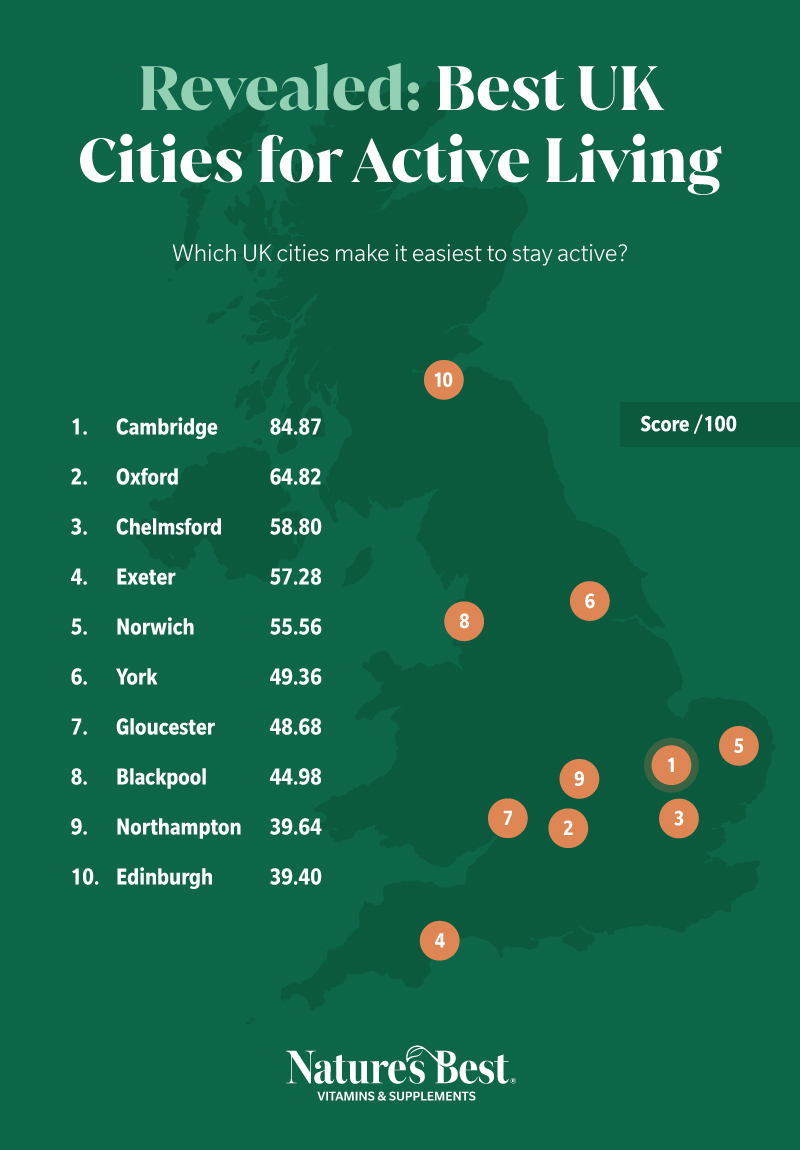
Cambridge takes the top spot overall, scoring 84.87 out of 100, making it the UK’s best place for an active lifestyle, thanks to its strong mix of facilities.
Across the factors analysed, the location had the largest number of green spaces (14), Sauna Listings (8) and Gyms (37) relative to its population, all of which contributed to its place on the ranking.
Oxford came in second place on the list with a score of 64.82, performing well for its cycle routes, parkrun locations and padel courts, while Chelmsford in Essex rounded off the top three with a score of 58.80 out of 100.
Interestingly, at the other end of the scale, Birmingham and Manchester rank lowest, scoring just 7.36 and 9.54, respectively. Despite offering a wide range of facilities and being among some of the biggest cities in the UK, both fell behind due to fewer trail routes, swimming pools, pilates studios and gyms relative to their population size.
While some cities show a clear focus on health and fitness, others lag behind, highlighting both the opportunity for greater investment in these facilities and the important role they play in supporting overall health.
Where it’s best to stay active this summer
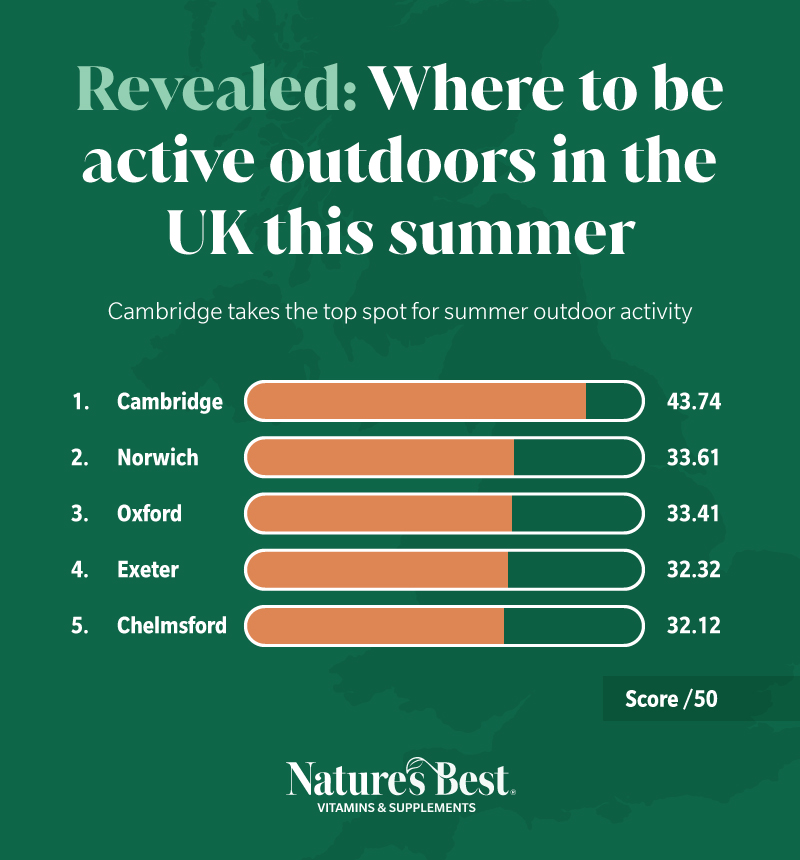
Summer brings more opportunities to get outside and stay active, and the data reveals a varied picture across the UK. Access to outdoor activity differs widely by location, with Cambridge ranking top once again, scoring 43.74 out of a possible 50.
Known for its natural landscapes, Cambridge earned high marks for its strong number of green spaces within a ten-minute walk (14), alongside 381 cycle routes and 99 walkable trails relative to its population.
That score is more than five times higher than London, which ranks near the bottom in 36th place with just 8.05 out of 50. Despite its large number of parks, green spaces and cycle routes, the capital falls behind when these are considered against its population size.
Norwich takes second place with a score of 33.61, performing strongly for its average daily sunshine hours in summer (8.9), making it easier for residents to get outside and stay active.
Spending time exercising outdoors not only supports physical health but also boosts overall well-being. Just 10 to 30 minutes in summer sunlight can help support vitamin D production, which has been linked to immune health and maintaining strong bones, teeth and muscles.
Oxford, Exeter and Chelmsford complete the top five, scoring 33.41, 32.32 and 32.12, respectively.
Towards the bottom of the ranking, Manchester and Glasgow place among the lowest-scoring cities. Both record fewer sunshine hours, reinforcing how weather can limit opportunities to stay active outdoors.
Charlotte East, Nutrition Expert at Nature’s Best (BSc Human Nutrition and Health), comments on the findings:
“These results show how strongly our surroundings can shape our daily habits, especially during the summer months. Access to green space, walkable routes and longer daylight hours make it far easier for people to build movement into their everyday routines.
“That consistency matters. Regular movement supports mobility and plays a wider role in overall health, with research suggesting people are also more likely to make healthier food choices when they spend more time outdoors, driven by improvements in mood and wellbeing.
“But that experience is not equal everywhere. In areas with less sunlight and fewer outdoor options, staying active can feel far less accessible, which may have a longer-term impact on both physical and mental health.”
The Top 5 cities for indoor sports, revealed
Staying active is not just seasonal. Keeping moving year-round, alongside a balanced diet, is one of the most effective ways to support overall health and wellbeing.
That is why we also looked at which parts of the UK offer the best access to indoor facilities, helping people maintain their routines when the weather is less predictable.
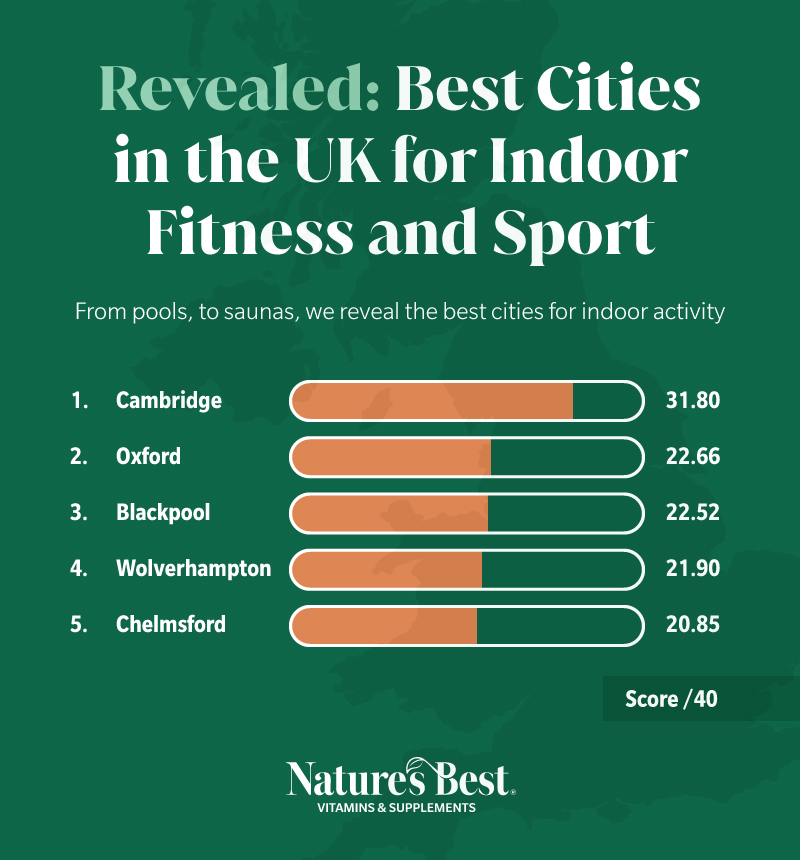
Analysing gyms, saunas, swimming pools and pilates studios to create a score out of 40, Cambridge once again came out on top, with a score of 31.80.
Regular gym-based exercise, including interval and weight training, has been linked to improved bone strength and muscle development. When combined with supplements such as glucosamine, it may also help support joint health, improve mobility and reduce discomfort as we age, highlighting the importance of access to these facilities throughout the year.
Oxford ranks second with a score of 22.66 out of 40.
Somewhat surprisingly, Blackpool completes the top three with a score of 22.52. Despite being one of the UK’s smaller cities, with an estimated population of just 145,007, it offers a high number of gyms, saunas and swimming pools relative to its size.
Tips to stay fit and healthy this summer
Below, Lucy Kershaw, Nutrition Expert (BSc Nutrition & Food Science) at Nature’s Best, shares her top advice on how to stay fit and healthy, even when your routine shifts this summer.
1. Incorporate exercise into your everyday routine
While summer often brings lighter evenings and warmer weather, busy social schedules can quickly derail even the best intentions.
Building movement into your daily routine can make all the difference. If you commute by train, consider getting off a stop earlier to add in a walk. Alternatively, use your lunch break to head to the gym or go for a walk, helping to boost your mood and leave you feeling more productive for the rest of the day.
2. Maintain a balanced diet where possible
With more trips to the pub and social events, it can be easy to rely on convenience foods and let healthy habits slip. But a busy schedule does not mean you have to compromise on nutrition, it simply requires a little more planning.
Bringing healthy snacks or lunches to work, or eating before heading out, can help you avoid relying on fast food options.
3. Get enough sleep
Longer, lighter evenings can disrupt sleep routines, but a lack of rest can negatively affect your sleep cycle, leaving you feeling fatigued and low in energy.
While occasional late nights are inevitable, try to maintain a consistent sleep routine and aim for around 7 to 9 hours of sleep each night, where possible.
4. Stay hydrated
Warmer temperatures make it easier to become dehydrated, particularly if you are drinking alcohol more frequently. Dehydration can affect energy levels, memory and mood.
To stay hydrated, carry a bottle of water with you throughout the day. If you are out for drinks, alternating alcoholic drinks with water can help you stay balanced.
Methodology
We analysed 40 of the UK’s most popular cities to identify where active lifestyles are most accessible. Using publicly available data, each location was scored across 10 key factors:
- Gyms (within 5 miles)
- Pilates studios (within 10 miles)
- Swimming pools (within 5 miles)
- Bookable padel courts
- Green spaces (within a 10-minute walk)
- Saunas
- Parkrun locations (within 10 miles)
- Cycle routes
- Trail routes
- Average summer sun hours
Each metric was then normalised and scored out of 10, creating a total score out of 100 for every city.
To ensure fair comparisons, population sizes were rounded to the nearest 10,000 and all data points were calculated on a per capita basis.
Sources:
YELP Find Pilates Near Me Fields in Trust Komoot Climate Data World Population Review